Architecture
Overview
polyglot-adapter is a multi-module Maven repository organized around a runtime adapter for dynamic languages built on top of the GraalVM Polyglot API.
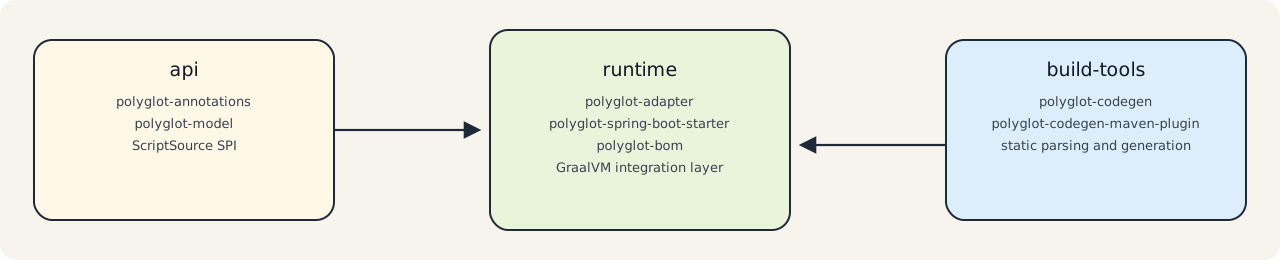
The codebase is split into three logical layers:
api
  ├─ polyglot-annotations
  └─ polyglot-model
runtime
  ├─ polyglot-bom
  ├─ polyglot-adapter
  └─ polyglot-spring-boot-starter
build-tools
  ├─ polyglot-codegen
  └─ polyglot-codegen-maven-plugin
This split is intentional:
apicontains shared contracts and does not depend on GraalVM execution or Springruntimecontains the adapter API implementation and application integrationbuild-toolsowns static analysis and source generation
Architectural Responsibilities
API Layer
The API layer is the common vocabulary shared by runtime and tooling.
polyglot-annotations provides:
@PolyglotClientSupportedLanguageConvention
polyglot-model provides:
- the contract model used by generators and parsers
- the portable polyglot type system
LanguageParserandScriptDescriptorCodegenConfig- the
ScriptSourceSPI used by the runtime
The API layer is deliberately free of GraalVM Context, Spring beans, and code generation implementation details.
Runtime Layer
The runtime layer is the actual GraalVM polyglot integration layer. It adapts Java contracts to guest-language execution.
polyglot-adapter provides:
AbstractPolyglotExecutorPyExecutorJsExecutorPolyglotHelperScriptSourceimplementations for classpath, filesystem, memory, and delegation- runtime exception types
AbstractPolyglotExecutor is a shared runtime base class used by the repository implementation. It should not be treated as a stable external subclassing SPI.
polyglot-spring-boot-starter adds:
- autoconfiguration for Python and JavaScript executors
- one
ScriptSourcebean per enabled language @EnablePolyglotClientsscanningPolyglotClientFactoryBean- optional actuator health/info and Micrometer metrics integration
- startup warmup, optional script preload, and fail-fast client validation
Current fail-fast validation in the Spring starter works by eagerly instantiating discovered client beans during startup, not by a separate metadata-only validation pass.
polyglot-bom is a consumption aid. It aligns runtime module versions with GraalVM dependencies for applications using the adapter.
Build-Tools Layer
The build-tools layer performs static contract extraction and Java source generation.
polyglot-codegen provides:
- parser dispatch through
DefaultContractGenerator - Python contract parsing
- Java type rendering
- Java interface source generation
- a small CLI entry point
polyglot-codegen-maven-plugin integrates the generator into Maven and registers generated sources during generate-sources.
JavaScript contract generation is not implemented yet. The runtime supports JavaScript execution as
an experimental bounded path, but the current code generator throws
UnsupportedOperationException for JavaScript contracts.
Adapter Flow On Top of GraalVM
The runtime adapter follows this flow:
- The application chooses a
ScriptSource. - An executor creates or receives a GraalVM
Context. - The executor resolves the script name from the Java interface name.
- The script is loaded and evaluated.
- The executor validates that the expected guest export exists.
bind(...)creates a Java proxy that delegates interface method calls into the guest runtime.
Python Path
PyExecutor converts the interface simple name from camel case to snake case to locate the script. For ForecastService, it looks for forecast_service.py.
After evaluation it resolves the exported contract by interface name:
- first from polyglot bindings
- then from Python language bindings
It supports:
- class-style exports, where the exported value is executable and instantiated once
- object-style exports, where the exported value is a dictionary-like map of functions
Resolved Python targets are cached per Java interface using weak references. Source caching is also per Java interface, and there is no automatic hot reload when scripts change after startup. The startup preload path is separate raw script evaluation and does not populate those interface caches.
JavaScript Path
JsExecutor resolves the script name the same way, for example forecast_service.js.
It evaluates the script once per interface and expects interface methods to map to executable
JavaScript functions in language bindings. There is no separate exported-object convention like the
Python path currently uses. This JavaScript path should be treated as experimental support before
1.0.0.
Starter-managed executors are singleton beans that serialize access to their shared GraalVM
Context. This makes them suitable for normal concurrent Spring application use, but it does not
imply source isolation or live reload semantics.
Script Resolution
The runtime depends on ScriptSource instead of performing I/O directly. Current implementations are:
ClasspathScriptSourceFileSystemScriptSourceInMemoryScriptSourceCompositeScriptSourceSpringResourceScriptSourcein the Spring starter
This abstraction was introduced during the runtime refactor that replaced older resource-loading assumptions with a single SPI shared across execution environments.
Code Generation Flow
The build-time pipeline is:
- Discover supported script files.
- Infer language from file extension.
- Build a
ScriptDescriptor. - Parse the script into a
ContractModel. - Render deterministic Java interfaces.
- Write generated sources under the configured output package.
Current parser coverage:
- Python: implemented, including class-style and dictionary-style exports
- JavaScript: declared extension point only, not implemented
How Java Interacts With Dynamic-Language Code
At runtime, Java does not call Python or JavaScript through handwritten Value member lookups. Instead:
- a Java interface defines the contract
- a script is resolved by convention through
ScriptSource - the adapter evaluates the script inside a GraalVM
Context - the adapter binds the contract and delegates method calls through GraalVM interop
This is the core architectural role of polyglot-adapter: it is not a replacement runtime, but an adapter API layered on top of GraalVM polyglot execution.
Code Generation and Runtime Integration
The code generation tooling is intentionally separate from runtime execution, but both parts are designed to work together.
polyglot-codegenparses supported script contracts into a neutral modelpolyglot-codegen-maven-pluginturns those contracts into Java interfaces during the buildpolyglot-adapterbinds those interfaces at runtime using the same naming and contract conventions
This separation keeps the build tools independent from GraalVM runtime execution while still producing Java types that fit naturally into the adapter API.
How Users Interact With the Runtime Adapter
There are two supported integration styles.
Direct Adapter Usage
Applications instantiate PyExecutor or JsExecutor directly and pass a ScriptSource.
This path gives explicit control over:
- context customization
- script locations
- validation timing
- lifecycle ownership
Spring Boot Usage
Applications add polyglot-spring-boot-starter, enable language-specific properties, and annotate contracts with @PolyglotClient.
The starter handles:
- context creation through
SpringPolyglotContextFactory - executor beans
- contract scanning and binding
- operational surfaces such as health, info, metrics, and startup logging
Architectural Evolution From Git History
Recent repository history highlights the main design direction:
- code generation was split into its own build-tools parent and decoupled from runtime execution
- runtime script loading was standardized around the
ScriptSourceSPI - the Spring starter gained warmup, metrics, actuator integration, and more stable auto-configuration
- Python code generation added support for both class-style and dictionary-style exports
Those changes reinforce the current architecture: shared contracts in api, adapter execution in runtime, and static generation in build-tools.