Runtime
Overview
The runtime layer provides the adapter API on top of GraalVM Polyglot for Python and experimental JavaScript execution.
Its core purpose is simple: bind a Java interface to a guest-language implementation and call it as normal Java code.
Note The runtime adapter is intended for trusted application embedding. It is not a sandboxing framework.
Core Runtime Module
runtime/polyglot-adapter is framework-neutral and contains the execution model used by every integration style.
Main Components
AbstractPolyglotExecutor: shared proxy binding, source caching, metadata, and common invocation helpersPyExecutor: Python-specific script loading, export resolution, instance caching, and binding validationJsExecutor: experimental JavaScript-specific script loading, function lookup, and binding validationPolyglotHelper: language-specificContextcreation and initializationScriptSourceimplementations: classpath, filesystem, in-memory, and composite resolution
How Runtime Execution Works
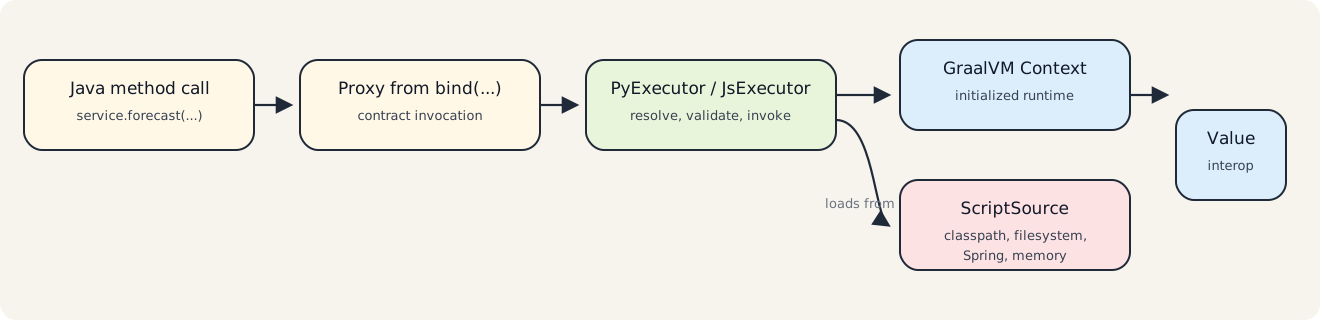
Context Creation
PolyglotHelper creates a language-specific Context.Builder, applies an optional customizer, builds the context, and calls context.initialize(languageId).
Current defaults:
allowAllAccess(true)allowExperimentalOptions(true)- interpreter-only warnings disabled
- Python experimental feature warnings disabled
For Python, context creation uses GraalPyResources.contextBuilder(...) with a virtual file system. For JavaScript, it uses the regular Context.newBuilder(...).
Security warning:
allowAllAccess(true)grants guest code unrestricted access to host Java types, I/O, and environment variables. These defaults are intended solely for trusted scripts that are part of the application. Do not use the adapter to execute untrusted or user-supplied scripts. Seeruntime-semantics.mdfor the full security contract.
Script Resolution
Executors never read the filesystem or classpath directly. They ask ScriptSource whether a logical script exists and open it through a Reader.
Logical names are derived from interface names:
StatsApi->stats_apiForecastService->forecast_service
The actual physical path depends on the chosen ScriptSource.
Binding and Invocation
bind(Class<T>) creates a JDK dynamic proxy. Each interface method becomes a guest-language method call with the same method name.
At invocation time:
- the proxy delegates to the executor
- the executor resolves or loads the guest script
- the guest function or object member is invoked through GraalVM
Value - the result is converted back through
Value.as(returnType)
If the guest result is null, the proxy returns null.
If the Java method has a void return type, the guest function is called normally and the result
is discarded without any type conversion.
Failures during guest execution surface as adapter exceptions (InvocationException,
BindingException, ScriptNotFoundException, EvaluationException). PolyglotException thrown
by guest code during proxy method invocation is wrapped as InvocationException with the original
PolyglotException as the cause. All are unchecked. See
runtime-semantics.md for the full exception contract.
Python Runtime Details
PyExecutor is convention-driven.
Expected Layout
- Java interface:
ForecastService - script:
forecast_service.py - export name:
ForecastService
Supported Export Styles
Class-style export:
polyglot.export_value("ForecastService", ForecastService)
Dictionary-style export:
polyglot.export_value(
    "ForecastService",
    {
        "forecast": forecast
    }
)
The executor:
- evaluates the script
- resolves the export from polyglot bindings first, then Python bindings
- instantiates callable exports
- reuses dictionary-style exports directly
- caches resolved targets per interface using weak references
validateBinding(...) resolves the instance eagerly, so it is useful at startup when applications want to fail early.
Python Lifecycle And Cache Semantics
- Source cache is keyed by Java interface type.
- Instance cache is keyed by Java interface type and stored via weak references.
clearSourceCache()clears only source entries; live Python instances remain reusable until instance cache is invalidated.invalidateContractCache(iface)evicts source + instance entries for that single contract.reloadContract(iface)is a focused helper: evict that contract cache and eagerly re-validate it.- Script changes are not auto-detected. To pick up changed code, invalidate/reload the affected contract or recreate the executor.
The more explicit repository-level contract for these behaviors is documented in
runtime-semantics.md.
JavaScript Runtime Details
JsExecutor uses the same script naming convention but a different binding model.
Expected layout:
- Java interface:
ForecastService - script:
forecast_service.js - functions in JS bindings:
forecast(...)
When a Java interface is validated or called:
- the script is evaluated once and cached by interface
- each interface method must exist as an executable JavaScript function
- method calls are executed from language bindings
The runtime does not currently define a separate JavaScript export object convention comparable to Python's class-style and dictionary-style exports.
JavaScript support is intentionally narrower than Python in this release line and is currently treated as experimental runtime-only binding support, not parity with Python lifecycle semantics.
Adapter API Surface
Applications normally interact with the runtime through:
PyExecutor.create(...)orPyExecutor.createWithContext(...)JsExecutor.create(...)orJsExecutor.createWithContext(...)for the experimental JavaScript pathbind(...)bind(..., convention)validateBinding(...)validateBinding(..., convention)metadata()
metadata() returns a lightweight snapshot intended for diagnostics, actuator info, or metrics. It is not a stable serialization format.
Binding Conventions
The runtime currently exposes three convention values:
DEFAULTBY_INTERFACE_EXPORTBY_METHOD_NAME
Current behavior:
- Python:
DEFAULT: backward-compatible export-based bindingBY_INTERFACE_EXPORT: explicit export-object/class conventionBY_METHOD_NAME: direct function lookup from bindings by Java method name- JavaScript:
DEFAULT: function lookup by method nameBY_METHOD_NAME: same runtime path asDEFAULTBY_INTERFACE_EXPORT: rejected explicitly
Important compatibility note:
- Python invocation behavior under
DEFAULTremains aligned with the historical export-based path. - Python validation under
DEFAULTis now stricter: if the exported contract exists but required Java methods are missing or not executable,validateBinding(...)fails earlier than before.
Spring Boot Starter
runtime/polyglot-spring-boot-starter wraps the runtime adapter for Spring applications.
What It Provides
PolyglotAutoConfigurationPolyglotPythonAutoConfigurationPolyglotJsAutoConfigurationSpringPolyglotContextFactoryPolyglotExecutors@EnablePolyglotClientsPolyglotClientRegistrarPolyglotClientFactoryBean- actuator contributors
- Micrometer meter binder
- startup warmup lifecycle
How Users Interact With the Runtime Adapter in Spring
- Add the starter and language runtime dependencies.
- Enable the desired languages under
polyglot.*. - Annotate interfaces with
@PolyglotClient. - Enable scanning with
@EnablePolyglotClients. - Inject the generated Spring beans as normal interfaces.
If @EnablePolyglotClients does not declare basePackages, the starter scans the package of the
importing configuration class.
Language resolution rules for @PolyglotClient are enforced by PolyglotClientFactoryBean:
- one explicit language: use that executor
- multiple explicit languages: fail
- no explicit language and exactly one executor available: use it
- no explicit language and multiple executors available: fail and require explicit configuration
Spring Configuration
Current configuration properties live under polyglot.*.
Core properties:
polyglot.core.enabledpolyglot.core.fail-fastpolyglot.core.log-metadata-on-startuppolyglot.core.log-level
Python properties:
polyglot.python.enabledpolyglot.python.resources-pathpolyglot.python.safe-defaultspolyglot.python.warmup-on-startuppolyglot.python.preload-scripts
JavaScript properties:
polyglot.js.enabledpolyglot.js.resources-pathpolyglot.js.warmup-on-startuppolyglot.js.preload-scripts
Operational properties:
polyglot.metrics.enabledpolyglot.actuator.enabledpolyglot.actuator.info.enabledpolyglot.actuator.health.enabled
Starter behavior:
polyglot.core.fail-fast=trueeagerly instantiates discovered@PolyglotClientbeans during startup so invalid contracts fail before the application begins serving requests.polyglot.core.log-metadata-on-startup=trueemits a single startup summary at the configuredpolyglot.core.log-level.polyglot.python.preload-scriptsandpolyglot.js.preload-scriptsevaluate the listed logical scripts during startup after warmup. These names are resolved through the configuredScriptSource; they are not interface names, they do not populate interface caches, and repeated evaluation or repeated script side effects remain possible on later contract binding.polyglot.python.safe-defaults=trueapplies the starter's recommended GraalPy defaults. When disabled, the starter creates a more minimal Python context and expects applications to provide their ownPolyglotContextCustomizerbeans if they need additional options.
Operational Behavior
If actuator is present, the starter can expose:
- a health indicator that reports whether at least one executor is available
- an info contributor with configuration and executor availability
If Micrometer is present, the starter registers gauges for:
- executor enablement
- source cache size
- Python instance cache size
- count of Python bound interfaces
- count of JavaScript loaded interfaces
Current Runtime Limits
- The runtime is intended for trusted application embedding, not untrusted sandbox execution.
- JavaScript execution is supported as an experimental bounded path, but JavaScript contract generation is not.
- Startup preloading evaluates named scripts but does not provide hot reload or source versioning.
- Startup preloading is raw script evaluation, not true contract prebinding.
- The binding convention is currently opinionated and name-based; alternative conventions are not implemented yet.
- Starter-managed executors are shared singleton beans that serialize access to the underlying
GraalVM
Context. They are intended for concurrent Spring application use, but contract loading and cache invalidation remain per-executor concerns. - Source caching is keyed by Java interface. Python target instances are cached per interface using weak references. Changing a script after startup does not trigger automatic reload; clear caches or recreate the executor if you need to pick up changed sources.